Oil Prices Fall as Diplomatic Signals Reshape Market Expectations
A measured analysis of the latest market reaction to emerging U.S.–Iran diplomatic signals, examining why oil prices are falling while gold rises, and how investor behaviour, expectations, and geopolitical uncertainty are reshaping economic outcomes in real time.
Markets moved early.
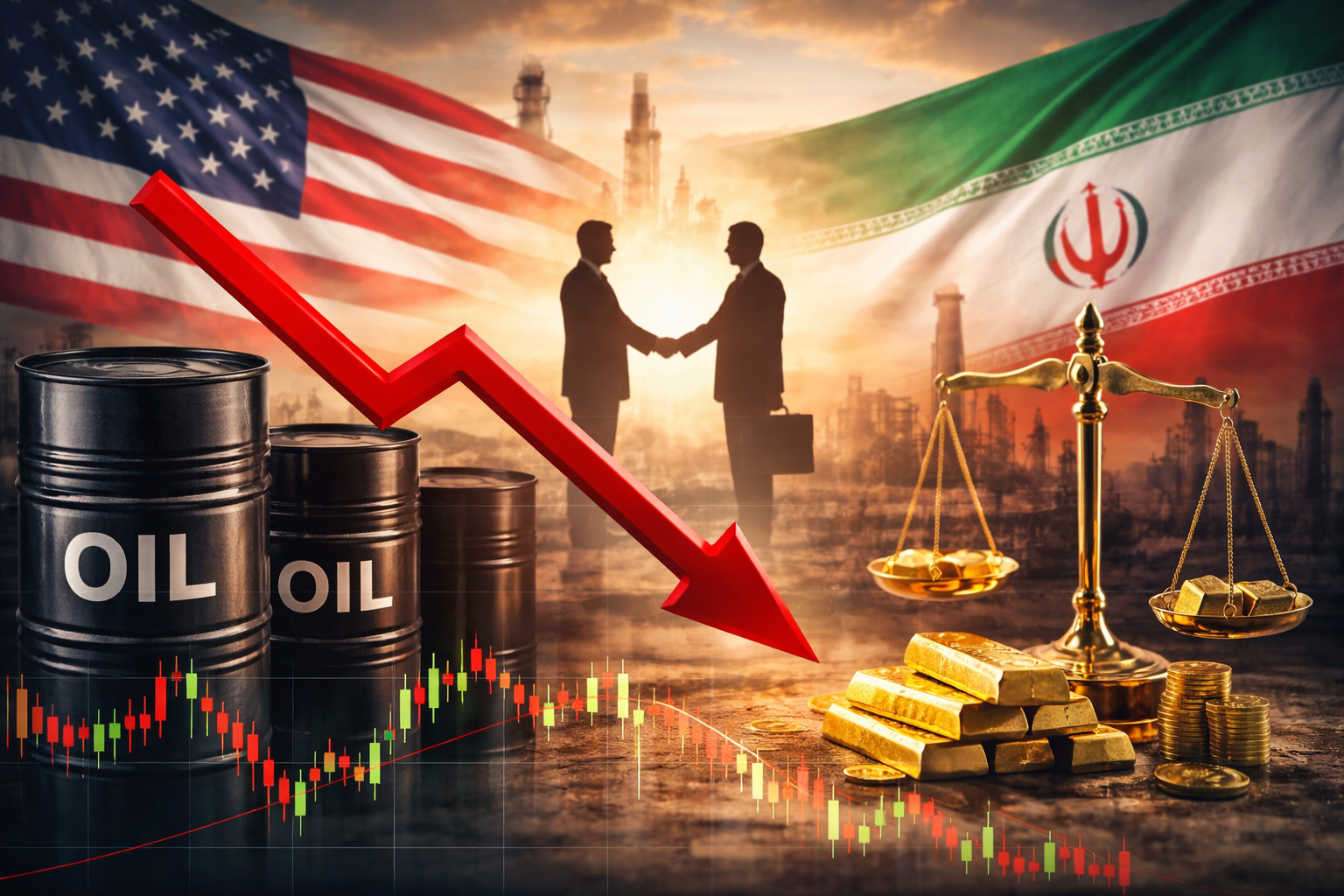
Before any agreement was signed, before any formal statement confirmed a shift in policy, oil prices began to fall. On March 25, both Brent crude and West Texas Intermediate declined by roughly 4–5%, reversing gains that had been built on the expectation of prolonged instability in the Middle East.
The trigger was not resolution.
It was the introduction of possibility.
Reports emerged that the United States, through intermediaries in Pakistan, had delivered a structured diplomatic proposal to Iran—an early-stage effort aimed at de-escalation. No formal acceptance has been announced. No terms have been publicly confirmed. And yet, the signal alone was enough to alter market behaviour.
This is how modern markets operate.
They do not wait for outcomes.
They move on trajectories.
Oil had risen under the assumption that disruption would continue—supply chains strained, transit routes threatened, regional instability sustained. When that assumption weakened, even slightly, prices adjusted. Not because the risk disappeared, but because its probability shifted.
At the same time, other markets responded in ways that, at first glance, appear contradictory.
Gold rose.
Bitcoin held steady.
Equity futures edged upward.
These are not opposing reactions.
They are layered responses to uncertainty.
Falling oil prices suggest a reduced expectation of immediate supply disruption. Rising gold reflects continued caution—an acknowledgement that the situation remains unresolved. Stability in cryptocurrency markets and modest gains in equities indicate a tentative return to risk tolerance, though not a full embrace of it.
Each movement captures a different time horizon.
Short-term relief.
Medium-term uncertainty.
Long-term recalibration.
All occurring simultaneously.
Central banks are watching closely, but their concern is not limited to oil.
It is behavioural.
Recent commentary from senior monetary officials suggests that businesses may no longer wait for disruption to occur before adjusting prices. Lessons from earlier inflation cycles—where delays in response amplified economic pressure—have been internalized. Companies may now act pre-emptively, raising prices in anticipation of instability rather than in response to it.
This introduces a second layer to the current moment.
Even if geopolitical tension eases, the economic response may not.
Inflation, in this context, becomes less tied to events and more tied to expectation. If businesses act as though disruption will continue, some of its effects may persist regardless of whether it does.
The system begins to reflect its own assumptions.
And those assumptions can outlast the conditions that created them.
Still, the underlying reality remains unchanged.
There is no agreement.
The reported proposal is an early diplomatic framework—one step removed from negotiation, and several steps removed from resolution. Key details remain undisclosed, including the scope of potential concessions, enforcement mechanisms, and timelines for implementation.
Regional dynamics further complicate the picture. The Middle East remains a network of interdependent tensions, where bilateral negotiations are influenced by multiple actors, existing sanctions, and long-standing security concerns. Any shift in one area reverberates across others.
Energy markets, in particular, remain highly sensitive to these signals.
The Strait of Hormuz continues to serve as a critical chokepoint for global oil shipments. Even minor changes in perceived risk to this corridor can produce outsized effects on pricing, as traders adjust for potential disruptions in flow and transport.
This is why the recent decline in oil prices should not be mistaken for stability.
It is not stability.
It is reassessment.
Markets are recalibrating in real time, integrating new information while holding existing risks in place. The result is not clarity, but a narrowing of possibilities—a shift in how likely each outcome appears.
In the days ahead, additional signals will shape that perception. Inventory reports, shipping data, and official government statements will provide more concrete indicators of direction. Central bank communications may further clarify how policymakers interpret the evolving landscape.
But even as new information arrives, the pattern remains consistent.
Crisis introduces tension.
Signals introduce adjustment.
Adjustment reshapes expectation.
By the time outcomes are confirmed, markets have already moved.
This is not anticipation.
It is adaptation.
For now, the system remains balanced between two states—escalation and de-escalation, risk and relief, assumption and revision. Investors are not choosing between them. They are positioning within both.
And so, oil falls.
Not because the conflict has ended, but because the certainty of its continuation has weakened.
That distinction matters.
Because in markets, as in systems more broadly, change rarely begins with resolution.
It begins with doubt.