Airport Security Pay Standoff Turns Routine Travel Into a Daylong Calculation
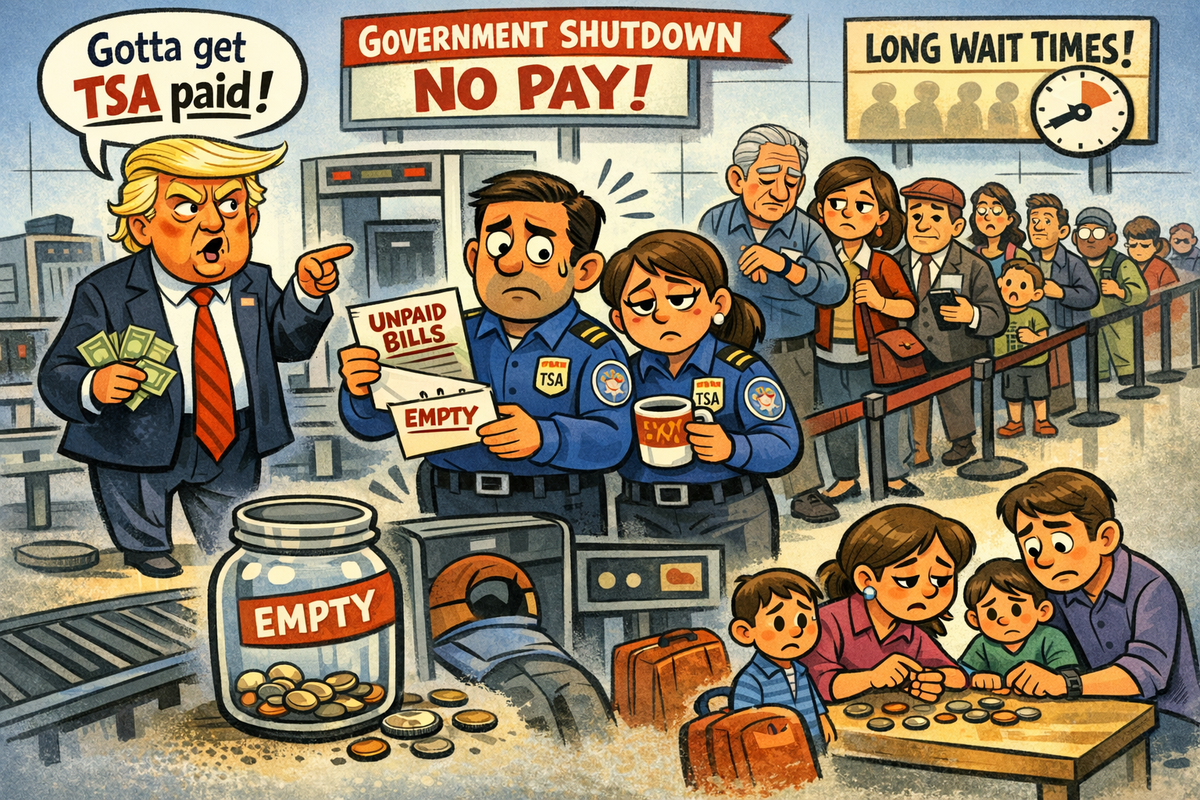
President Donald Trump on Friday directed his administration to find a way to pay Transportation Security Administration employees, after weeks of missed paychecks during the partial shutdown of the Department of Homeland Security began to show up in one of the most ordinary places in modern life: the airport security line.
By Friday evening, the story had become larger than a fight over congressional procedure and smaller than a grand national emergency at the same time. It was visible in the practical rhythm of travel. People were leaving home earlier than they expected. Families were standing in winding queues with children and carry-on bags. Airport workers were reporting for shifts without knowing when their next full pay would arrive. A system built around routine timing had started to depend on improvisation.
The White House memorandum, issued Friday, said more than 60,000 TSA employees were not being paid because of the shutdown, including about 50,000 transportation security officers working at domestic airports. The memo said nearly 500 officers had left their positions since the funding lapse began in mid-February, that thousands more were calling out sick at record rates, and that wait times at some airports had stretched to three hours or more. Trump directed the Homeland Security secretary and the Office of Management and Budget to use funds with what the memo called a reasonable and logical connection to TSA operations to provide compensation and benefits, consistent with applicable law.
That order came after the Senate reached a deal early Friday to restore funding for parts of Homeland Security, including TSA, the Coast Guard and the Federal Emergency Management Agency, but the House did not take up the measure. The shutdown had entered its sixth week. The immediate political dispute in Washington centered on immigration enforcement, border funding and the terms Democrats wanted attached to any broader Homeland Security bill. But for travelers and airport staff, the more immediate reality was physical and repetitive. A line that barely moves. A shift that still has to be worked. A morning that has to be rebuilt around delay.
At Houston airport, a BBC reporter described waiting for about two hours in a long queue, going up an escalator and finding another line still ahead. Jim Szczesniak, director of aviation for the Houston Airport System, told the BBC that only about a third to half of TSA checkpoints there were operating. The airport became a clear example of how a budget fight can descend from the level of legislation to the level of posture and patience: people standing, checking phones, scanning clocks, moving bags from one shoulder to the other, trying to judge whether there is still enough time.
Air travel is often stressful, but it is also heavily routinized. People know roughly when to leave for the airport, how long a security line is supposed to take, and how much margin to build into a connection. Once that rhythm fails, a series of quiet recalculations begins. Travelers arrive earlier, eat at different times, send more updates, and hesitate before leaving the line even briefly. The disruption does not only delay movement. It changes behaviour while people wait.
For TSA employees, the pattern has been harsher. Security officers have continued showing up to perform public-facing work while the question of pay remained unresolved. The White House memorandum described an emergency situation and said officers were working without knowing whether they would be able to buy food for their families or pay rent. BBC reporting said hundreds had quit and others were missing work as the strain deepened. The pressure is visible not only in headline numbers but in the narrow economics of ordinary households: the grocery trip postponed, the bill timed more carefully, the conversation at the kitchen table becoming more exact.
That is part of what makes this a revealing news story about everyday life rather than only about institutional breakdown. Airports are places where many different routines briefly meet. Business travelers trying to keep to a schedule. Parents carrying snacks and spare clothes through a checkpoint. Students heading home. Older travelers managing medication, mobility and fatigue. People flying for weddings, funerals, job interviews and hospital visits. When staffing falls and queues lengthen, the effects are uneven but widely legible. Some people can absorb a long wait with inconvenience. Others have less room in the day.
The same is true on the worker side. A missed paycheck does not land evenly. For some households, it means drawing down savings. For others, it means choosing which payment can wait. That is a familiar divide in American life, and one that becomes especially visible when essential workers are told to remain at work while formal budget authority stalls. The work continues. So do rent, groceries, commuting costs and child care. What changes is the level of strain required to keep the routine intact.
There are several ways to interpret the political fight that produced this moment, and Friday’s statements reflected that divide. Republicans blamed Democrats for withholding support for a broader Homeland Security funding bill. Democrats said they would fund core security functions but would not approve more immigration enforcement money without reforms. Those arguments matter because they determine what Congress may do next. But they also risk obscuring the more concrete fact already visible at airports: an argument about federal power has been converted into longer waits, thinner staffing and more fragile household budgeting.
Seen closely, the story is not only that the airport line got longer. It is that time itself became less reliable for the people inside it. When routine breaks down in a place designed for controlled movement, people begin to make smaller adjustments. They keep children closer. They text apologies. They stop assuming the timetable will hold. Workers do something similar from the other side of the conveyor belt, stretching attention across longer shifts, higher absence rates and the low morale that comes from public-facing responsibility without financial certainty.
What changed on Friday was not a full resolution. It was an acknowledgment from the White House that the pressure had become too visible to ignore. The memorandum may provide temporary financial relief for TSA workers if it can be implemented as directed, but the broader Homeland Security funding fight remained unresolved by the end of the day. That left the underlying pattern in place: the country was still watching a dispute in Washington express itself through crowded terminals and strained household math.
There is a particular clarity to stories like this because they reveal how public systems are felt not only through law or rhetoric but through timing, proximity and repetition. A shutdown can sound abstract until it changes when people leave home, how long they stand in a line, whether a worker can count on a paycheck, or how carefully a family has to arrange the next few days. By Friday, that translation had already happened. The political conflict was still being argued in official language. Its effects were already being lived in ordinary routines.