Oil Prices Climb Again, Turning a Distant War Into a Household Budget Problem
Oil prices rose sharply again on Friday as investors grew more doubtful that the war involving Iran would end quickly, pushing fuel costs higher at the same time many households were already stretched by food, housing and utility bills. By the end of the day, Brent crude, the global benchmark, had settled at $112.57 a barrel and U.S. crude had settled at $99.64 after briefly touching $100, a level that tends to move quickly from commodity screens into gas station signs, delivery invoices and family budgeting decisions.
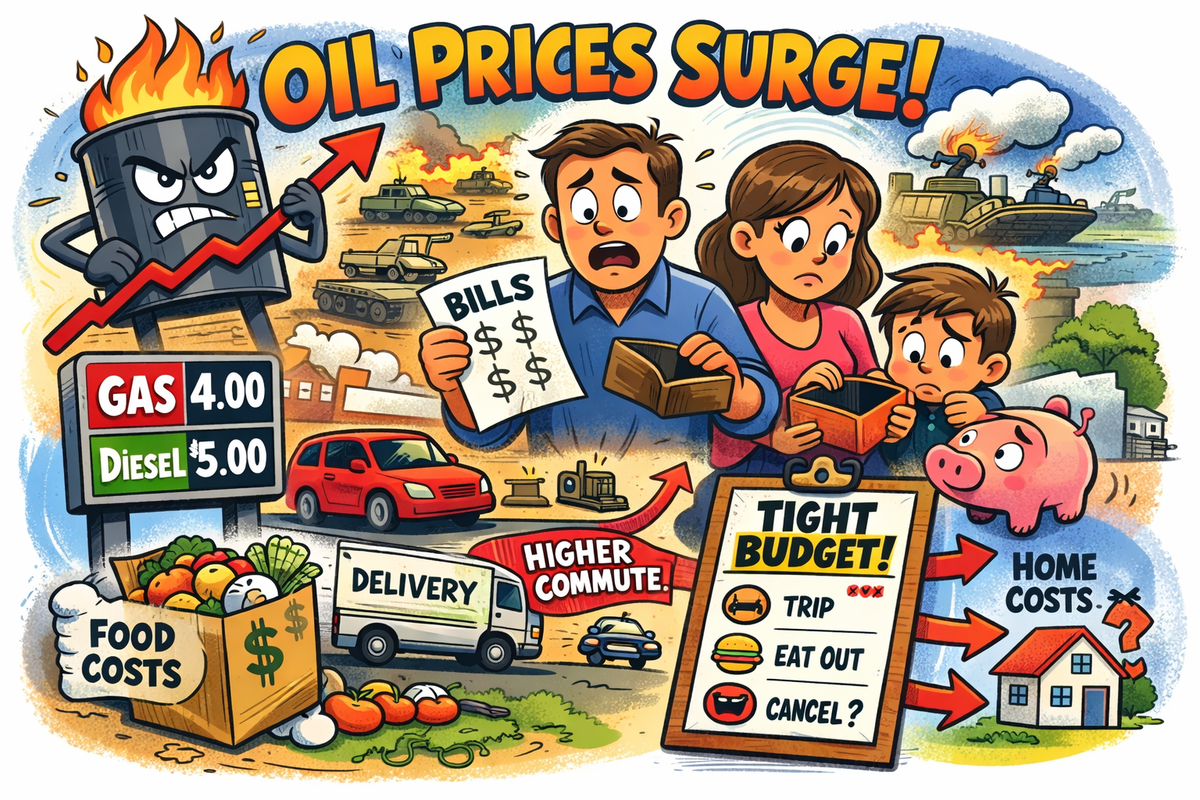
That translation is already underway. The national average price for regular gasoline in the United States reached $3.98 a gallon this week, up $1.01 over the past month. Diesel moved above $5 a gallon. Consumer sentiment fell in March to 53.3, its lowest reading since December, as households reported fresh concern about gas prices and financial volatility. The story on Friday was not only that markets fell, though they did. It was that another week of higher energy costs has begun to change the everyday arithmetic of getting to work, buying groceries, making deliveries and deciding whether a large purchase can wait.
The immediate cause remains the disruption around the Strait of Hormuz, the narrow waterway between Iran and the Gulf states that normally carries about 20 million barrels of oil a day, or roughly one-fifth of global daily supply. The strait has remained largely shut to normal tanker traffic during the conflict, and the United Kingdom's maritime authorities have reported repeated attacks on vessels in the area. Energy producers have kept searching for alternate routes and workarounds, and governments have tried to calm markets by drawing on stockpiles. But the basic constraint has not changed. A central transport corridor for oil and fuel has been severely disrupted, and the cost of moving energy through the system has risen with it.
That matters because fuel shocks rarely stay in the fuel category. Gasoline is the most visible part of the problem because drivers see the price in large numbers every time they pass a station, but the same rise feeds into freight, food distribution, air travel, ride-hail work, farm operations and home heating in some areas. Diesel is especially important here. When diesel prices rise, trucking becomes more expensive, and those costs eventually reach wholesalers, retailers and households. The increase is not always immediate, and it does not land evenly, but it widens pressure across ordinary spending rather than remaining confined to one monthly bill.
Friday's reporting also showed how quickly energy pressure moves into other parts of daily life that seem only loosely connected to oil. Mortgage rates rose this week for a fourth straight week, with the average 30-year fixed rate reaching 6.38 percent, as bond markets adjusted to the risk that higher fuel costs could keep inflation elevated. For a household trying to buy a home, that changes affordability in concrete terms. On a $450,000 purchase with a standard down payment, the difference between a rate from a month ago and one available now amounts to more than $1,100 a year. That does not affect everyone. But for buyers already balancing child care, insurance, commuting distance and repair costs, it can be the difference between moving forward and stepping back.
The burden is also uneven in a way that says something important about the structure of daily life. Households with flexible work arrangements can try to drive less, shift errands, or remain at home more often. Delivery workers, tradespeople, home health aides, commuters in outer suburbs and residents of rural areas usually have less room to adapt. Their fuel use is tied more directly to earning an income or reaching basic services. A parent with a long school run, a nursing assistant driving across counties, or an independent contractor paid per delivery does not experience a price jump as a distant economic signal. It arrives as a smaller margin, a delayed payment, a cancelled outing or a tighter food budget.
There is also a timing problem built into gasoline markets. Prices at the pump tend to rise fast when crude becomes more expensive, but they fall back more slowly even when oil retreats. Refiners need time to process cheaper crude, distributors need time to move it, insurers and shippers need confidence that routes are safe, and station owners usually lower prices only gradually. This is why even brief diplomatic optimism has not offered immediate relief to drivers. The underlying logistics remain damaged, and physical systems do not reset on the same timetable as political messaging.
The broader context makes the effect more significant. Many households entered this latest fuel shock with very little slack. Grocery costs have stayed high for years. Rent and mortgage burdens have remained heavy. Insurance, utilities and repairs take a larger share of income than they did before the pandemic. Wage growth has helped some workers keep up, and the labor market has not collapsed, but that is not the same as saying daily life feels secure. When another essential cost rises suddenly, families do not respond in abstract ways. They combine trips, postpone visits, cut restaurant spending, delay maintenance, say no to optional driving and watch bank balances more closely between paychecks.
Officials and analysts are interpreting the situation in different ways. One view is that the world still has enough stored oil and enough spare production to absorb a short disruption. Another is that the physical damage to facilities, the interruption to shipping and the length of the closure are signs of a more durable shock. Both interpretations remain present in markets, which is one reason oil has been so volatile. Prices have been swinging not only on physical shortages but on the possibility that the conflict could either ease quickly or continue forcing adjustments across energy, transport and inflation.
What is clearer than the strategic debate is the practical change already visible on the ground. This is becoming a story about routines. About whether a family keeps a weekend trip, whether a driver takes one more job, whether a homebuyer accepts a higher monthly payment, whether a small business passes along delivery costs now or waits another week. Those are not dramatic decisions. They are repetitive ones. But they are how a geopolitical shock becomes part of ordinary life.
By Friday evening, the most important fact was not simply that oil had risen again. It was that the rise had started to harden into a broader set of constraints. Fuel is a transport cost, a food cost, a time cost and, increasingly, a housing cost. The war may be far from most American households, but the systems that connect work, shopping, travel and bills are not. What this moment shows, with unusual clarity, is how little distance now exists between a disrupted shipping corridor and the quiet decisions people make to keep a week manageable.