Australia Moves to Steady Fuel Supply as a Shipping Shock Spreads Through the Energy System
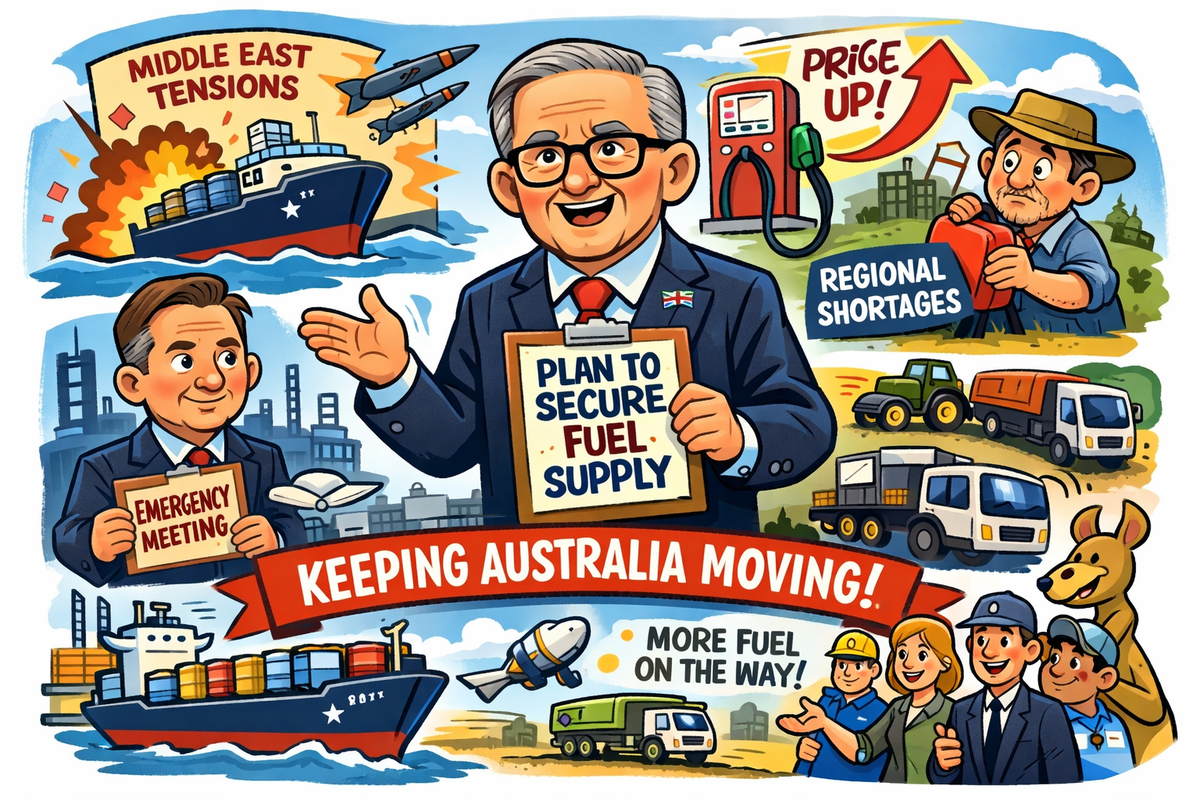
Australia’s government moved on Friday to calm fuel concerns and tighten coordination across the country after disruption in the Middle East pushed new stress through global oil and fuel supply chains. Prime Minister Anthony Albanese said the country’s near-term fuel outlook remained secure, even as shortages in some regional areas and rising costs showed how quickly an external shock can reach everyday transport, farm work and household budgets.
The announcement came after Albanese said the National Security Committee of Cabinet had met for the 16th time since the conflict in the Middle East began. He said the government would convene National Cabinet again on Monday, framing the issue not simply as a market event but as a national coordination problem involving industry, federal agencies and state governments. The immediate task, he said, was to ensure supply while limiting the effect of inflationary pressure already moving through the economy.
Energy Minister Chris Bowen said six fuel shipments to Australia that had previously been cancelled had now been replaced by alternative cargoes, with at least three additional cargoes also ordered by refiners and importers. For the next few weeks, he said, Australian supplies of petrol, diesel and oil would be at normal levels or higher. He also said six cargoes of jet fuel were currently on their way to Australia, with arrivals due between Saturday and April 8, a sign that aviation fuel flows remain intact ahead of the Easter travel period.
The government’s message was designed to separate aggregate supply from local disruption. Bowen said fuel volumes moving into regional areas had risen sharply, but that the system was still absorbing a surge in demand. He cited year-on-year increases in regional supply from major distributors, including gains of more than 30 per cent in parts of New South Wales and Queensland and nearly 50 per cent in Western Australia. Terminal sales at sites including Newcastle, Geelong, Esperance, Gladstone and Mackay were also running far above forecast for March, indicating that both supply and demand had moved upward at the same time.
That distinction matters. A country can have fuel arriving at its ports and still experience shortages on the ground if storage, trucking, terminal throughput and consumer behavior fall out of alignment. In Friday’s remarks, ministers acknowledged that some regional communities were facing real shortages and price pressure, especially where higher demand reached local distributors faster than replacement supply could move through the network. The government said it had already taken emergency measures, including releasing part of the minimum stockholding obligation and changing some fuel-quality settings to widen the range of usable supply.
The broader pressure on the system is visible well beyond Australia. U.S. Energy Information Administration data released this week showed that tanker rates for very large crude carriers leaving the Middle East for Asia reached their highest levels in March since at least November 2005. The agency said the increase followed Iran’s closure of the Strait of Hormuz on March 2 and reflected both physical risk to vessels and the cost of war-risk insurance. It also said the effective closure had trapped loaded tankers inside the Persian Gulf, reducing available global tanker capacity and pushing up freight rates on other routes as well.
Those details help explain why the present disruption is not only about the headline oil price. The system under stress is a transport system as much as a commodity market. When ships are delayed, diverted or held back, the result is not simply more expensive crude. It is a cascading shortage of available vessels, higher insurance costs, tighter schedules for refined products and more pressure on import-dependent distribution chains. Clean tanker rates and natural gas carrier rates have risen as well, according to the same U.S. data, widening the effect beyond crude alone.
Australia’s response has also taken on a regional diplomatic dimension. Earlier this week, Australia and Singapore issued a joint statement expressing deep concern about the Middle East situation and its effect on energy supply chains and prices. The two governments said they would work together to support the flow of essential goods, including petroleum products such as diesel and liquefied natural gas, and would consult each other on disruptions affecting energy trade. That language reflects a wider shift now visible across energy-importing economies: security is being measured not only in barrels and reserves, but in relationships, routing options and the ability to replace lost cargoes quickly.
There are at least two ways to read Friday’s developments. One is as evidence that the system is holding. Cancelled shipments have been replaced, more cargoes are on the way, and the federal government is using the machinery of cabinet, regulation and industry coordination to keep fuel moving. Another is as a sign of how little slack remains once an external shock hits shipping lanes that carry a large share of the world’s energy trade. Both readings are true. The first describes the response. The second describes the underlying condition.
This is where signal and noise begin to separate. The most important signal is not the visibility of empty pumps in a handful of towns, though those shortages are serious for the communities affected. It is the rise in freight costs, the substitution of cancelled cargoes, and the need for governments to actively manage stocks, standards and logistics in real time. Those are markers of system stress. Public anxiety and bursts of higher purchasing are real as well, but they sit closer to the surface. They amplify disruption more than they explain it.
What changed on Friday was therefore not the existence of the energy shock, which has been building for weeks, but the clarity of the official response. Australia’s government said more fuel is arriving, more is being pushed into regional markets, and more national coordination is coming. At the same time, the global shipping data show why that reassurance has limits: the transport layer of the oil system remains expensive, constrained and vulnerable.
For now, the observable picture is more orderly than chaotic. Cargoes are still moving. Replacement supply is being found. Governments are coordinating more closely across borders and within them. But the episode has made one point unusually clear. In an interconnected fuel system, energy security is not only a matter of what exists in reserve. It is a matter of what can still move, where it can land, and how steadily it can reach the people who need it.