EU Snapchat Probe Brings the Ordinary Routine of Teen Messaging Under Closer Official Scrutiny
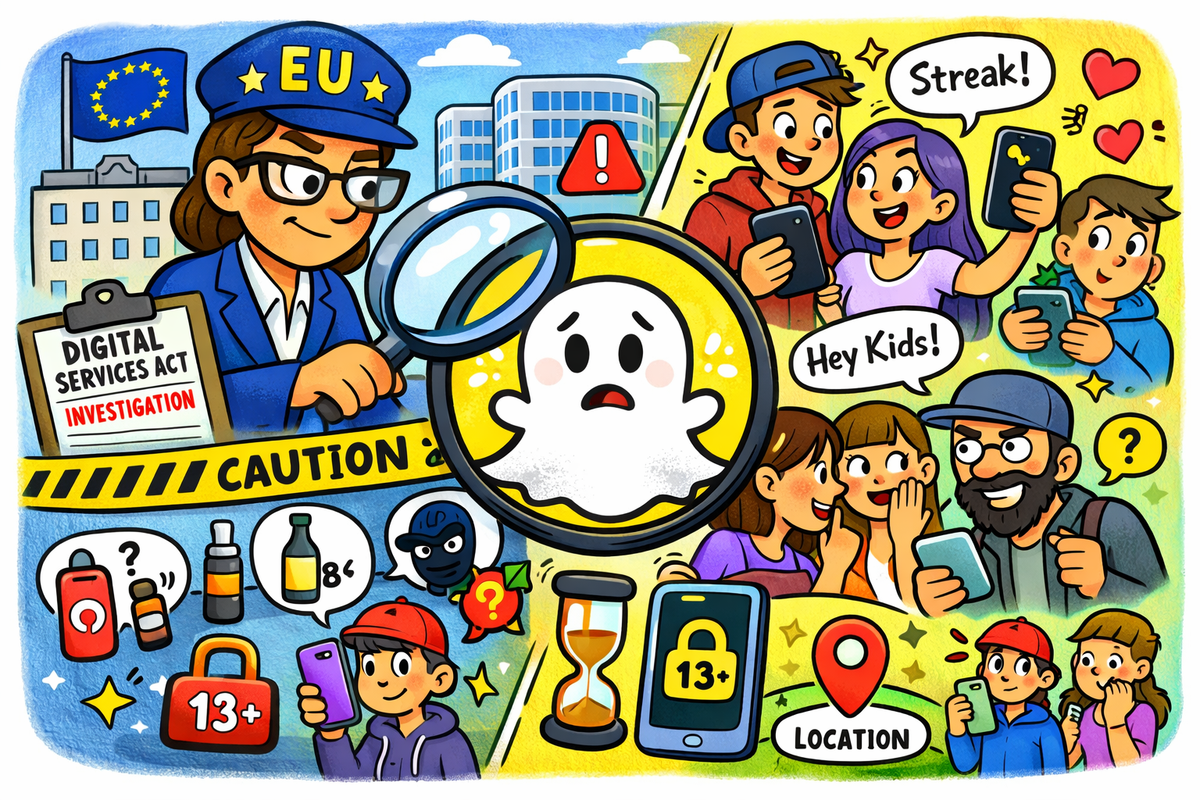
European Union regulators opened a formal investigation into Snapchat on Thursday, a move that turns a platform used for casual messages, group chats and daily check-ins into the latest test of how far governments should press social media companies to shape ordinary digital life for young users.
The European Commission said it was examining whether Snapchat is complying with the bloc's Digital Services Act, the rulebook that requires large online platforms to reduce risks to users. The focus in this case is child protection. Regulators said they were concerned that Snapchat may not be doing enough to verify age, prevent adults from posing as minors, limit contact from users with harmful intent, or stop younger users from encountering information about illegal or age-restricted products such as drugs, vapes and alcohol.
Snapchat said it had fully cooperated with the Commission and would continue to do so throughout the investigation. The company said user safety and well-being are a top priority and that the service was built with privacy and safety protections from the start, including additional safeguards for teenagers.
The news is regulatory, but the setting is deeply ordinary. Snapchat is not primarily a site people visit for a discrete task and then leave behind. For many teenagers, it is folded into the texture of the day: messages before school, photos from the bus, group conversations about homework, quiet exchanges during lunch, location sharing between friends, and the running social presence that continues after classes end. That is part of why questions about design, defaults and verification matter so much here. They do not sit outside routine. They shape it from within.
The Commission's concern about age assurance goes to the center of that pattern. Under the current system, regulators said, Snapchat requires users to be at least 13, but officials suspect the checks may be insufficient to keep younger children off the platform or to ensure that users under 17 receive an age-appropriate experience. They are also examining whether adults can misrepresent their age in ways that make it easier to contact minors. On paper, those are technical compliance questions. In practice, they touch the small judgments families and young users make every day about who is on the other end of a message, how much trust to place in a recommendation, and how much attention to give a contact request that appears inside an app already woven into social life.
That practical dimension is broader than parental oversight alone. Teenagers are often managing several digital expectations at once: to respond quickly, to maintain streaks and friendships, to stay visible to their peers, and to move easily between private conversation and group interaction. A platform does not need to be the entire social world to become one of its fixed routes. When that happens, safety features are not simply background tools. They become part of the social architecture people rely on without fully seeing it.
European officials said they were also concerned that Snapchat may not be sufficiently protecting minors from contact linked to sexual exploitation or recruitment for criminal activities. They questioned whether younger users could be exposed to information about restricted or illegal goods. Those findings have not been finalized, and the investigation is meant to examine the evidence in detail. But even at this early stage, the issues under review describe a familiar modern tension. Digital platforms are designed to reduce friction in social connection. Regulators are asking whether too little friction, for the wrong kinds of contact, can itself become a risk.
That is not an abstract debate for the households and institutions that live beside these platforms. Parents often do not encounter a social app as a product category or a regulatory subject. They encounter it through household negotiation: when a child asks to join, when notifications continue late into the evening, when a school friendship spills into a private chat, or when a device becomes both a social lifeline and a source of unease. Teachers and school staff experience something similar from another angle. Conflicts, rumors and social pressure that begin on phones do not stay there neatly. They travel back into classrooms, corridors and after-school conversations.
The Commission's action also fits into a wider pattern now visible on both sides of the Atlantic. Social media companies are facing sharper questions about how their systems influence young users, not only through content but through design choices, recommendation systems and default settings. Earlier this year, the EU accused TikTok of breaching the same law with addictive design features that regulators said could lead to compulsive use by children. The bloc has also been investigating Facebook and Instagram over child-protection concerns. In the United States, recent court cases have added to public pressure by focusing attention on what companies knew about harms to younger users and how they responded.
Still, the Snapchat case has its own everyday texture. Unlike debates centered on viral public posting, this one speaks to the more intimate side of platform use: direct contact, age ambiguity, recommendations, and the quiet way commercial or harmful material can appear within the flow of normal conversation. The app's appeal has long rested in part on informality. Messages feel light, fast and socially current. That ease is a feature. It is also what makes the regulatory question more pointed. When a service is built to feel casual, users may lower their guard in equally casual ways.
There are several ways to read the Commission's decision, and Thursday's statements leave room for that complexity. One interpretation is that European regulators are applying the Digital Services Act as intended, moving from broad principles to concrete enforcement on behalf of younger users. Another is that governments are now trying to impose formal accountability on platforms that grew by treating rapid social interaction as the default good. Snap's response reflects the other side of the picture: a company arguing that it has invested in safety and that it is engaging with regulators in good faith. For now, the factual point is narrower. The investigation has opened. The conclusions have not yet been reached.
What has already changed is the level of visibility around a behavior that had become routine enough to seem natural. Apps such as Snapchat have been absorbed into friendship, supervision, adolescence and family compromise so completely that many of their operating assumptions pass unnoticed until regulators stop on them and ask basic questions. Who is actually in this space. How is age being checked. What kinds of contact are made easy. What kinds of friction are missing.
That is why this story matters beyond the legal process now starting in Brussels. It shows that technology in everyday life is not defined only by the devices people carry or the apps they open most often. It is also defined by the unseen rules that organize access, contact and trust inside those habits. On Thursday, the European Commission turned those rules into the subject of a formal public inquiry. For millions of families and young users, the questions under review are more familiar than technical. They sit inside the daily routine of being online.