Mexico’s New Missing-Person Review Reopens a Familiar Wound for Families
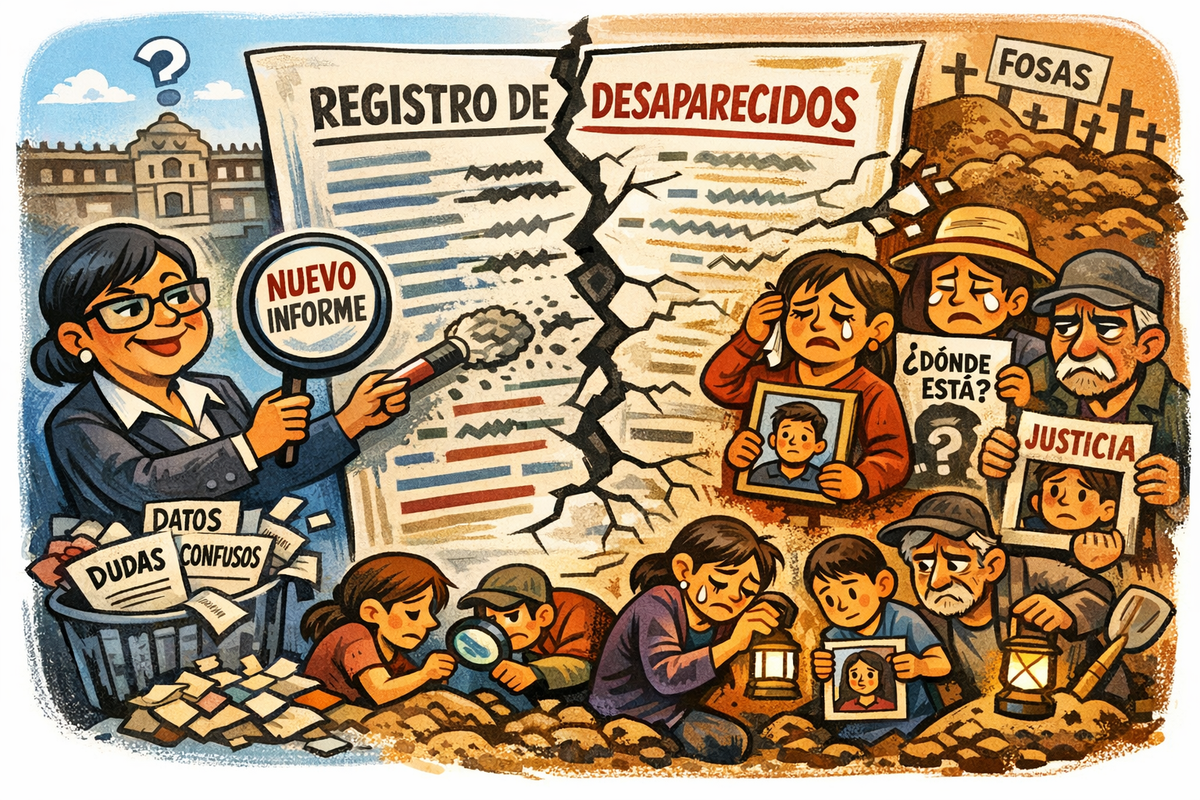
Mexico’s government said Friday that signs of life had been identified for roughly a third of the country’s 130,000 registered missing people, a finding officials described as evidence of a flawed national database but one that families of the disappeared received as another source of instability in a crisis that shapes daily life across the country.
The report, presented in Mexico City by senior security official Marcela Figueroa, said authorities had spent the past year reviewing the national registry of missing persons by cross-checking entries against tax filings, vaccination records, birth certificates, marriage registries and other government databases. According to the government, 40,367 people listed as disappeared showed some official activity after they were reported missing, suggesting they may still be alive and traceable. Officials said 5,269 people had already been located and reclassified as found.
On paper, the announcement appeared to offer a measure of clarity in one of Mexico’s deepest public traumas. In practice, it reopened a familiar argument over what the country’s disappearance figures really mean, who controls them, and how much trust families can place in a system that has long asked them to do much of the searching.
The disagreement is not only statistical. It is domestic and social. In Mexico, disappearance is not an abstract security issue contained to police files or courtrooms. It enters kitchens, alters routines, redraws family roles and can hold households in an unresolved state for years. A missing son or daughter does not create a clean division between grief and hope. It creates a suspended life in which parents continue to search, siblings adapt to a permanent absence, and ordinary decisions remain shaped by the possibility that the missing person could still be reached.
That is why Friday’s report drew immediate criticism from search collectives and human rights advocates. Héctor Flores, a search-group leader in Jalisco, one of the states most affected by disappearances, described the government’s methodology as misleading and insufficiently transparent. Advocacy groups argued that any official reframing of the registry risks minimizing the scale of the crisis or weakening search efforts. For families who have spent years pressing local authorities to open files, collect evidence and preserve records, a change in classification can feel less like administrative order than a shift in the ground beneath them.
Officials defended the review as an attempt to bring discipline to a chaotic database. The government said about 46,000 records, or 36% of the total, lack basic information such as names, dates or places of disappearance, making searches effectively impossible. Another 43,128 cases contain enough data to remain in the registry but show no activity in other government systems. Of those, officials said, fewer than 10% are under criminal investigation, an admission that pointed to longstanding failure by prosecutors and law enforcement rather than to any sudden improvement in the state’s search capacity.
Figueroa said not all disappearances are the same. Some, she said, appear to involve what officials call voluntary absences, including cases in which men left their partners or women fled abusive relationships and were later reported missing. The government also said past administrations allowed duplicate or incomplete entries into the registry by combining information from federal and state prosecutors, search commissions, citizen reports and activist groups without sufficient verification. Officials stressed Friday that cases would not simply be erased from the public record and that new legal reforms are intended to block future entries that do not include minimum identifying data.
Disappearances in Mexico have surged since 2006, when the country’s militarized campaign against drug cartels intensified. Over time, disappearances have become both a tactic of organized crime and a measure of institutional weakness. Cartels use disappearance to spread fear, conceal killings and control territory. Families and rights groups, meanwhile, have long accused local authorities of failing to investigate cases promptly or accurately, and in some instances of being implicated themselves. Some of the country’s most emblematic disappearances, including the case of the 43 students from Ayotzinapa, have reinforced the belief that families cannot rely on the state to tell a complete story.
That history shapes the reaction to any government effort to reinterpret the registry. Authorities see disorder in the data and argue that a cleaner system will improve investigations. Families see a long record of negligence and hear the possibility that real people may be reduced to questionable entries, duplicates or statistical corrections. Both positions emerge from the same underlying fact: the state’s recordkeeping has been unreliable for years. But they lead to very different social realities.
For officials, a registry is a management tool. For families, it is often the last formal proof that a disappearance has not been forgotten.
That difference matters because disappearance reshapes households in specific ways. It turns mothers into search organizers, fathers into document keepers, sisters into public advocates and children into witnesses to a form of waiting that has no timetable. Search collectives in Mexico are often built from that domestic labor. Families print flyers, compare fragments of information, travel to possible burial sites and attend meetings that the state should have made unnecessary. In many cases, the task of holding a disappearance in public view has shifted from institutions to relatives.
Friday’s report did acknowledge part of that institutional failure. Officials said local prosecutors will now be required to open investigation files in all disappearance cases, a change analysts said could mark a meaningful administrative step if it is enforced. But even that concession underscored how much of the crisis has been shaped by absence inside the state as much as absence inside families. A country does not reach more than 130,000 registered missing people through violence alone, but through years of fragmented databases, weak investigations, bureaucratic drift and uneven political will.
This is what makes the story larger than a dispute over numbers. The public registry is not only a ledger of the missing. It is also a record of how a society organizes recognition. When the data are incomplete, duplicated or disputed, families are left to live inside two uncertainties at once: uncertainty about what happened to the missing person, and uncertainty about whether the institutions recording that loss can be trusted.
The government’s report may eventually improve some searches if it produces cleaner records, more rigorous case files and better coordination between agencies. That remains a matter for implementation, not assumption. What is already visible is something else. In Mexico, the disappearance crisis has created a social structure in which families are asked to carry both emotional loss and administrative burden at the same time. They grieve, search, verify, advocate and monitor the state that is supposed to support them.
Friday’s announcement did not change that arrangement. It clarified it.
The immediate issue is whether the government’s review makes the registry more reliable. The deeper fact is harder to miss. In a country where so many people have vanished into violence, error or neglect, the argument over records is also an argument over recognition. Families are not only asking where their relatives are. They are asking whether the system can hold the truth of their absence without shrinking it to something easier to manage.