Iranian Strike on Saudi Air Base Wounds U.S. Troops and Tests U.S. Claims of Progress
An Iranian missile and drone attack on Prince Sultan Air Base in Saudi Arabia wounded U.S. troops and damaged aircraft, exposing the limits of U.S. claims of progress in the Iran war while deepening concerns over regional security, shipping through Hormuz, and global market stability.
An Iranian missile and drone attack on Prince Sultan Air Base in Saudi Arabia wounded at least 10 U.S. service members on Friday and damaged several American refueling aircraft, according to U.S. officials, marking one of the clearest signs yet that Tehran retains the ability to strike regional military targets even as Washington says its campaign is ahead of schedule.
The attack widened the sense that the month-old war has entered a more consequential phase. What had already been a conflict with broad regional spillover now appears to be testing the resilience of the U.S. military posture in the Gulf, the credibility of American claims about how much of Iran's military capability has been destroyed, and the willingness of allies to help manage the economic fallout from continued disruption around the Strait of Hormuz.
Two U.S. officials told Associated Press that at least 10 American troops were injured in the strike and that two of them were seriously wounded. The same officials said several U.S. refueling aircraft were damaged at the base. The attack involved both an Iranian missile and unmanned drones, according to the report. Prince Sultan Air Base has been targeted before during the conflict, but the latest strike was notable both for the scale of the damage described by officials and for its timing, coming just a day after President Donald Trump said Iran had been “obliterated” and Defense Secretary Pete Hegseth said no military in recorded history had been neutralized so quickly or so effectively.
Those statements were already under pressure before Friday's attack. Reuters reported that U.S. intelligence can only confirm with certainty that about a third of Iran's missile arsenal has been destroyed so far, while another third is believed to have been damaged, destroyed or buried in tunnels and bunkers. The remaining share is less clearly accounted for. That does not mean Iran's military position is intact. It does mean the war has not stripped Tehran of its ability to impose costs on its adversaries. Friday's strike on a Saudi base brought that distinction into focus.
U.S. Central Command said earlier Friday that more than 300 service members have been wounded over the course of the conflict. Most have returned to duty, but 30 remain out of action and 10 are considered seriously wounded overall. Thirteen U.S. service members have been killed since the war began. The cumulative toll matters because it shows that the campaign, however heavily weighted toward air power and standoff strikes, is no longer defined only by targets inside Iran. It is also being measured in injuries, damaged equipment and the durability of a regional military network that Washington depends on to sustain operations.
The broader diplomatic message from Washington remained one of control. Speaking after a meeting of G7 foreign ministers in France, Secretary of State Marco Rubio said the United States expected to conclude its operations in Iran in weeks, not months, and could achieve its objectives without using ground troops. He said the campaign was on or ahead of schedule. At the same time, he acknowledged that additional forces were being sent to the region to give the White House flexibility if conditions change. That combination of language suggested a familiar wartime posture: confidence in the formal objective, caution about the operational environment.
Rubio's remarks also underscored how tightly military developments are now linked to global trade and energy security. G7 ministers called for the permanent restoration of safe, toll-free freedom of navigation in the Strait of Hormuz, the narrow waterway through which roughly a fifth of the world's oil and liquefied natural gas normally passes. Iran has moved to close the strait and has threatened to impose fees on shipping. That pressure has turned a regional war into an economic event with global reach. The conflict is no longer only about battlefield attrition or diplomatic bargaining. It is also about whether the systems that move fuel, fertilizer and industrial inputs can function under sustained coercion.
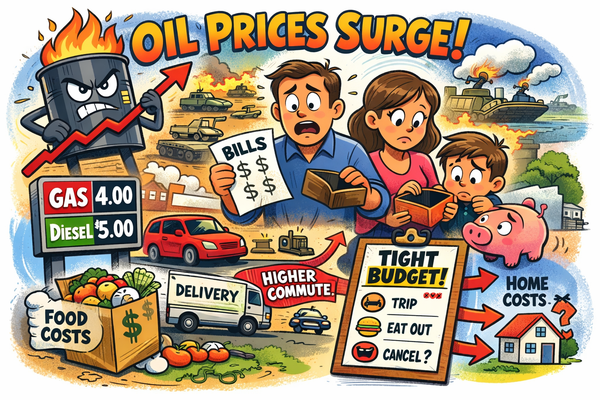
Markets reflected that pressure on Friday. Reuters reported that U.S. stocks fell sharply, with the Dow Jones Industrial Average closing in correction territory after dropping more than 10% from its February record. The S&P 500 and Nasdaq also extended their slide, each posting a fifth straight weekly decline. Oil prices climbed as well, with U.S. crude settling near $100 a barrel and Brent above $112. The move in markets was not driven by a single strike alone. It was driven by the pattern the strike reinforced: the war remains active, the disruption is not contained, and the assumption of a quick stabilization is still unproven.
That is the deeper significance of the Saudi base attack. It does not, by itself, reverse the battlefield balance. U.S. and Israeli forces have hit thousands of Iranian military targets, and Washington says Iranian missile and drone attacks are down sharply from the opening phase of the war. But the practical question is no longer whether Iran has been heavily degraded. It clearly has. The more relevant question is whether it retains enough survivable capability to keep widening the cost of the conflict across bases, shipping lanes, energy markets and allied infrastructure. Friday's events suggest the answer is yes.
There is also a political dimension to that answer. American officials have tried to present the campaign as both decisive and limited: forceful enough to destroy Iran's long-range strike capacity and nuclear ambitions, but contained enough to avoid a drawn-out regional war. That framing has become harder to sustain as the conflict spills into Saudi Arabia, the United Arab Emirates, Israel and commercial shipping routes. The attack on Prince Sultan Air Base showed that even after weeks of sustained bombardment, Iran can still reach beyond its borders in ways that complicate any simple account of progress.
For Gulf states, the strike sharpened an already difficult reality. They are not merely observers or rear-area partners in this war. They are exposed nodes in it. Their air bases, airports, residential districts, energy facilities and shipping lanes sit inside the conflict's operating range. Their interest is not only in ending attacks, but in ensuring that any eventual settlement reduces Iran's remaining capacity to turn regional infrastructure into leverage. That helps explain why discussions around the war are now as focused on navigation, tolls and supply chains as on missile counts and strike packages.
By the end of Friday, the central fact was straightforward. The United States is still describing the war as a campaign moving toward a defined conclusion. Iran is still demonstrating that it can wound troops, damage aircraft and shake the systems around the battlefield. Between those two realities lies the actual shape of the conflict: not a settled outcome, but an ongoing contest between military degradation and strategic disruption. The strike on Prince Sultan Air Base did not settle that contest. It clarified it.